


By Ahmed Rufa’i, Dutse
Jigawa State’s nominal Gross Domestic Product (GDP) rose to ₦5.65 trillion in 2023 from ₦3.62 trillion in 2019, while a new census has identified more than 1.1 million learners in non-formal education centres across the state.
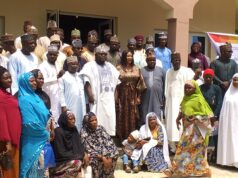
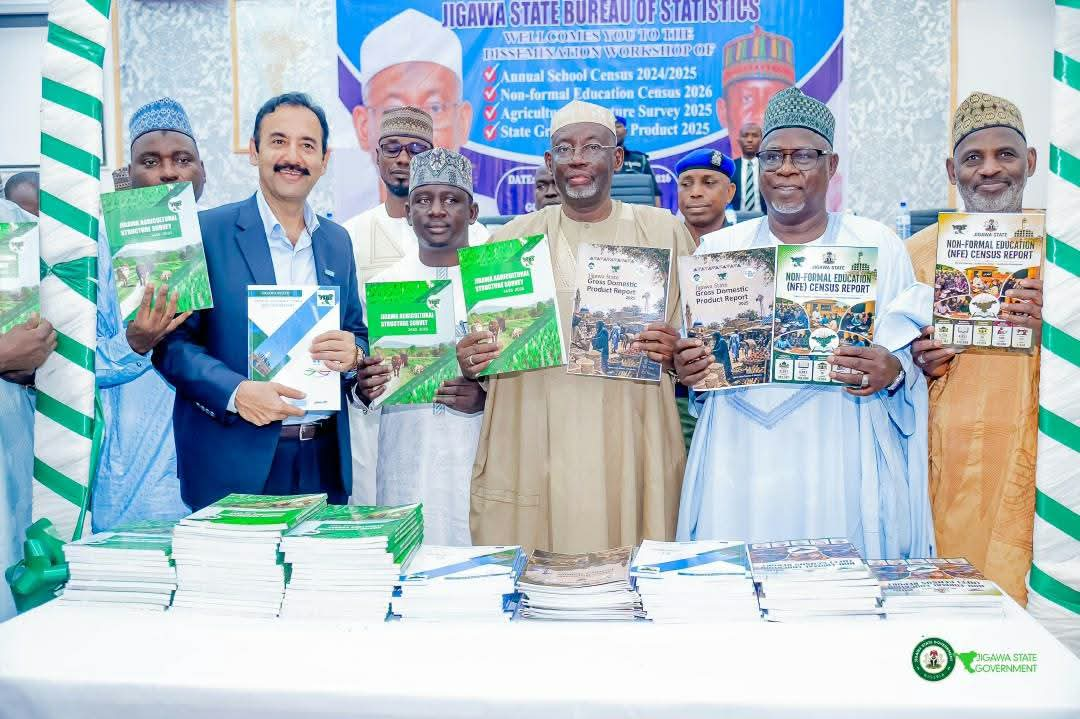
The figures were contained in four major statistical reports unveiled on Tuesday by Governor Umar Namadi at the Banquet Hall, Government House, Dutse.
The reports comprise the 2024/2025 Annual School Census, Non-Formal Education Census, Agricultural Structure Survey and Jigawa State GDP Survey covering 2019 to 2025.
Namadi said the findings would strengthen evidence-based governance, guide resource allocation and help his administration identify gaps in education, agriculture and economic development.
He described reliable statistics as essential tools for effective planning, accountability and the measurement of government performance.
“Statistics are not abstract figures. They are the backbone of socioeconomic planning, the basis for sound decisions and strategic resource allocation, and the means by which we assess performance and ensure accountability for results,” he said.

The Annual School Census recorded 1,320,770 pupils in public and private primary schools, including 752,921 girls, representing 57 per cent of the total enrolment.
It also documented 999,130 pupils in public primary schools, 214,166 students in public junior secondary schools and 137,795 in senior secondary schools. Another 167,975 children were enrolled in one-year pre-primary education.
Despite the enrolment figures, the report identified staffing pressures, with pupil-teacher ratios standing at 96:1 in public primary schools, 57:1 in junior secondary schools and 38:1 in senior secondary schools.
Although 84 per cent of public primary school teachers, 83 per cent of junior secondary school teachers and 82 per cent of senior secondary school teachers possessed the required qualifications, the governor said more teachers were needed to improve learning outcomes.
He cited the recruitment and regularisation of teachers, including the recent presentation of appointment letters to 2,020 teachers, as part of efforts to address staffing gaps.
The first comprehensive Non-Formal Education Census conducted across all 27 local government areas identified 10,197 centres serving 1,116,289 learners in Islamiyya and Tsangaya schools, adult education and vocational skills programmes.
The report also highlighted welfare challenges among Almajiri learners, with 66 per cent depending on community support for daily meals. It found that 61.1 per cent of sleeping facilities required major repairs, while 3.5 per cent were considered unusable.
Women accounted for 71.1 per cent of adult education learners, while females represented 1,804 of the 2,462 trainees enrolled in vocational and skills development programmes.
Namadi said the findings would guide efforts to improve the welfare of learners, strengthen integrated Tsangaya education and expand adult literacy and vocational training.
He added that the establishment of the Tsangaya Education Board formed part of his administration’s efforts to reform the sector and improve learning opportunities for children outside the formal school system.
The Agricultural Structure Survey, which covered 955,410 farming households, recorded 943,563 households engaged in crop production and 705,952 involved in livestock activities.
However, access to agricultural support services remained low, with only 7.1 per cent of farming households having contact with extension officers, 3.9 per cent accessing credit and 1.9 per cent belonging to cooperatives.
The survey further revealed that 91.1 per cent of farming households did not keep farm records, while irrigation adoption stood at 15.1 per cent.
On food security, 25.2 per cent of households were fully food secure, while 34.3 per cent experienced severe food insecurity.
The governor said the findings would inform policies to expand irrigation, improve access to agricultural finance, strengthen extension services, promote cooperative farming and accelerate the transition from subsistence to commercial agriculture.
On the state’s economic performance, the GDP Survey put Jigawa’s nominal GDP at ₦5.65 trillion in 2023, compared with ₦3.62 trillion in 2019.
Namadi said the economic data would support investment promotion, diversification, job creation and long-term development planning.
To ensure the reports translate into measurable improvements, the governor directed the Jigawa State Bureau of Statistics to work with the Ministry of Budget and Economic Planning and relevant ministries, departments and agencies to integrate the findings into sector performance reviews, medium-term strategies and annual budget preparation.
He also directed government institutions to involve the Bureau in major data-gathering exercises, from design and collection to validation, analysis and dissemination, to prevent duplication, reduce costs and protect the credibility of official statistics.
“These publications must become working instruments for action—not reports kept on shelves. Their value will ultimately be measured by better schools, wider learning opportunities, more productive agriculture, stronger economic growth, and improved public services,” he said.
The governor reaffirmed his administration’s commitment to evidence-based governance, effective implementation and accountability in delivering development outcomes for the people of Jigawa State.